Research

My PhD connects the mechanics of elastic waves with the design of materials: how magnetic fields tune waves in active polymers, which models describe that honestly, and how architected lattices absorb and dissipate energy.

PhD research

Wave Mechanics and Metamaterials Laboratory, Technion, since 2023, with Dr. Pavel Galich.

Which elastic waves can a magnetic field tune?

Starting from an enriched magnetoelastic energy, I derived closed-form speeds for longitudinal and shear waves in compressible magneto-active polymers. Without pre-deformation, only one mode responds to the field: the shear wave polarised along it. Ultrasonic pulse-echo measurements on 3D-printed iron–PLA under fields up to 1.6 T confirmed exactly that selectivity.

International Journal of Mechanical Sciences, 2025. Article
The three bulk waves, computed from the closed-form speeds. Only the shear wave polarised along the field changes speed.

Surface waves on magneto-active solids

I formulated the Rayleigh surface-wave problem for a magneto-active half-space under magnetic fields parallel and perpendicular to its surface. The formulation recovers the classical Rayleigh equation without a field, and shows how the surface wave's speed and depth of penetration respond to the field.

Advances in Applied Mechanics, 2026, in press. Article

A Rayleigh wave with exact kinematics: particles trace ellipses that reverse direction a fifth of a wavelength below the surface.

Choosing material coefficients that respect physics

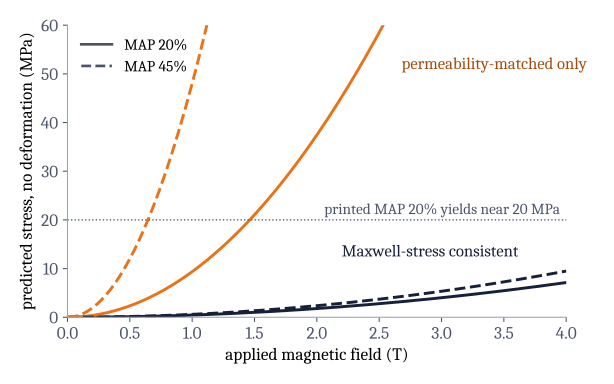
Matching a measured magnetic permeability is not enough to fix a magnetoelastic model. Unless the coefficients also recover the Maxwell stress of the undeformed material, the predicted stresses can exceed the material's strength many times over, and the predicted waves soften toward instabilities that experiments do not show. I proposed Maxwell-stress consistency as a selection criterion.

Talk at ICME 2026, Technion; part of the Advances in Applied Mechanics article.

Chart: predicted stress against magnetic field. Maxwell-stress-consistent models stay below about 10 MPa up to 4 tesla; models matched only to permeability exceed the material's 20 MPa yield stress below 1.5 tesla.
Predicted stress with no deformation, for two iron–PLA compositions.

Friction and confinement in auxetic lattices

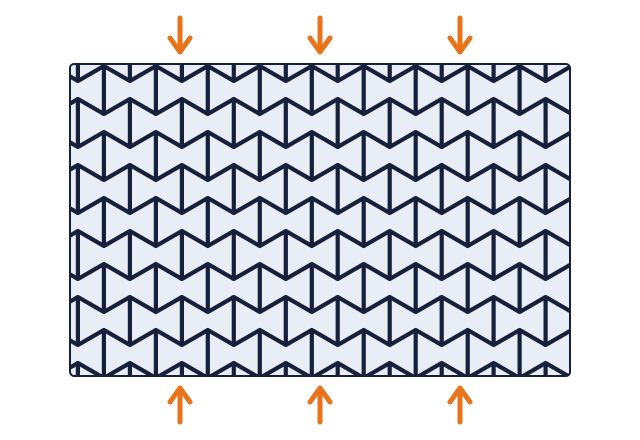
Re-entrant auxetic lattices absorb energy by collapsing their cells. I showed with analytical models, COMSOL simulations and experiments that adding friction and confining the lattice in a tailored matrix improves both the energy it absorbs and the energy it dissipates.

Manuscript under review.

Drawing of a re-entrant auxetic lattice embedded in a matrix, compressed from above and below.
A re-entrant lattice in a confining matrix, under compression.

Multistable cells from bistable arches

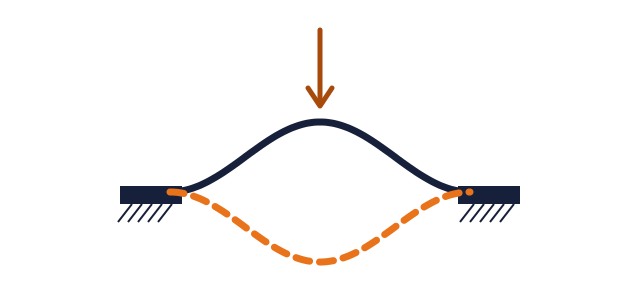
Early in the PhD I designed a unit cell that combines bistable arches into a structure with several stable states, a route to shape-changing and energy-trapping metamaterials.

Talk at IACAS-63, Technion, 2024.

Drawing of an arch in its two stable states, snapped up and snapped down by a downward force.
A clamped arch and its second stable state.

Before the PhD: tyre mechanics

In industry I built finite-element procedures for two-wheeler and truck-bus radial tyres and validated them against experiments. Two studies came out of that work: on ply bulge failures, and on symmetric belt laminates that reduce belt-edge separation. Both are listed under Publications.

What I plan to do next

Three questions, each pointing toward a component.

Low frequencies in small cells

Can field-responsive materials inside architected cells give compact, tunable attenuation below a few hundred hertz?

Dissipation that repeats

How can lattices dissipate energy again and again, for damping, isolation and impact, including in high-temperature alloys?

Isolation for critical payloads

How light can an isolator for a seeker, cryocooler or navigation unit become while still surviving launch and shock?

Research areas

  • Magneto-active polymers and magnetoelasticity
  • Elastic bulk, surface and guided waves
  • Mechanical and elastic metamaterials
  • Vibration isolation
  • Energy absorption and dissipation
  • Experimental and computational mechanics